What Is CRM and Why Businesses Need It Today

If you talk to most growing businesses, you’ll hear a familiar story. Customer data lives in too many places. Sales teams keep their own spreadsheets. Marketing uses separate tools. Support teams rely on inbox threads and ticket systems that don’t talk to anything else. Over time, information gets lost, follow-ups are missed, and customers feel like they’re starting from zero every time they interact with the company.
This is exactly the problem Customer Relationship Management, or CRM, is designed to solve.
CRM is often described as software, but in practice it’s much more than that. It’s a structured way of managing customer information, tracking interactions, and building long-term relationships at scale. In today’s market—where customers expect speed, personalization, and consistency—CRM has moved from being “nice to have” to business-critical.
Let’s break down what CRM really is and why it matters more now than ever.
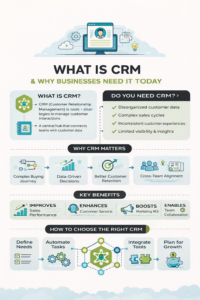
Understanding CRM in Practical Terms
CRM stands for Customer Relationship Management. At a basic level, it is a system that stores and organizes customer data. But a modern CRM does far more than hold contact records.
A CRM platform becomes the central working space for customer-facing teams. It captures leads, tracks conversations, records purchases, logs support issues, and shows how each customer moves through the buying journey. Instead of scattered notes and disconnected tools, everything sits in one connected environment.
Think of it as a shared memory for the business. No matter who speaks with the customer next, they can see the full context—what was discussed, what was promised, and what happened before.
This shared visibility changes how teams operate.
Why CRM Has Become Essential, Not Optional
Customer behavior has changed dramatically over the past decade. Buyers now research independently, compare options online, read reviews, and interact across multiple channels before making a decision. They might visit your website, download a guide, open three emails, and speak to a sales rep—all before purchasing.
Without a CRM, these touchpoints remain disconnected. With a CRM, they form a continuous timeline.
Businesses today need that continuity for three main reasons: complexity, competition, and customer expectations.
Complexity has increased because there are more channels and more data. Competition has increased because digital tools make it easier for new players to enter the market. Customer expectations have increased because people are used to personalized experiences from leading brands.
CRM helps businesses respond to all three pressures in a structured way.
The Real Value: A Single Source of Truth
One of the most overlooked benefits of CRM is alignment. When sales, marketing, and support teams use separate systems, each team develops its own version of the customer story. This leads to duplicated work and inconsistent communication.
A CRM creates a single source of truth.
Marketing can see which campaigns generated which leads. Sales can see which pages a prospect visited and what content they engaged with. Support can see what was sold and what was promised. Leadership can see pipeline health and revenue forecasts without chasing reports across departments.
When everyone works from the same data, decisions improve and friction drops.
How CRM Improves Sales Performance
Sales teams benefit from CRM almost immediately. Instead of managing leads through inboxes and spreadsheets, they can track opportunities through defined pipeline stages. Every deal has an owner, a value, a probability, and a next step.
This structure brings discipline to the sales process. Follow-ups are scheduled instead of remembered. Reminders are automated instead of manual. Managers can see where deals stall and where reps need help.
Over time, patterns emerge. Teams learn which lead sources convert best, which deal stages cause delays, and which activities correlate with wins. That insight is difficult to produce without a CRM backbone.
How CRM Strengthens Marketing Efforts
Marketing without CRM data is mostly guesswork. You can run campaigns, but connecting them to revenue is harder than it should be.
With CRM integration, marketing teams can track leads from first touch to closed deal. They can segment audiences based on real behavior, not assumptions. Campaigns become more targeted because they are built on known attributes and past interactions.
It also enables more relevant communication. Instead of sending the same message to everyone, marketers can tailor content based on lifecycle stage, industry, engagement level, or purchase history.
Relevance improves response rates. Response rates improve return on investment.
Customer Service Becomes Faster and More Consistent
Support teams often inherit the consequences of poor information flow. When customer history is missing, every ticket starts with basic questions. Customers repeat themselves. Frustration grows.
A CRM-connected support setup gives service agents immediate context. They can see past purchases, earlier complaints, open deals, and previous conversations. That visibility shortens resolution time and improves the tone of interactions.
It also helps identify recurring issues. When multiple tickets relate to the same product or process, trends become visible. Businesses can fix root causes instead of repeatedly treating symptoms.
CRM and Automation: Doing More Without Adding Headcount
Another reason CRM adoption is rising is automation. Modern CRM systems include workflow tools that handle repetitive tasks automatically.
Leads can be assigned based on rules. Follow-up emails can trigger after specific actions. Scores can be calculated based on engagement. Tasks can be created when deals move stages.
Automation does not replace people; it removes low-value manual work so teams can focus on higher-value conversations and decisions. For growing businesses, this often delays the need to expand headcount while still increasing output.
Better Forecasting and Smarter Decisions
Many leadership decisions depend on accurate forecasts. Without structured pipeline data, forecasts rely on intuition and scattered reports.
CRM systems generate real-time dashboards based on live records. Leaders can see pipeline value, stage distribution, win rates, campaign performance, and revenue trends in one place. Forecasts become evidence-based rather than opinion-based.
This level of visibility supports better budgeting, hiring, and planning.
CRM Is Not Only for Large Enterprises
There is still a common misconception that CRM is only useful for large organizations. In reality, small and mid-sized businesses often see the fastest gains because they move from unstructured to structured processes quickly.
A small team using a CRM from an early stage builds good habits around data, follow-ups, and reporting. As the business grows, the system grows with it. Waiting too long usually means painful data cleanup and process redesign later.
The key is choosing a CRM that matches current needs while allowing future expansion.
Choosing the Right CRM Approach
Not every business needs the most complex platform. The right choice depends on goals and maturity.
Some companies primarily need sales pipeline tracking. Others need strong marketing automation. Some require deep customer support features. Integration requirements also matter—email, analytics, e-commerce, and finance tools often need to connect smoothly.
The best CRM is not the one with the longest feature list. It is the one teams actually use consistently.
Adoption matters more than capability.
Final Perspective
At its heart, CRM is about memory and continuity. It ensures that customer relationships are not dependent on individual employees remembering details or maintaining personal notes. It turns relationship management into an organizational capability rather than a personal skill.
Businesses today operate in a fast, data-heavy, customer-driven environment. CRM provides the structure needed to manage that environment with clarity and control.
Companies that invest in CRM early tend to communicate better, respond faster, and grow more predictably. Not because the software is magical, but because the discipline it introduces changes how teams work with customers every day.
#Business CRM #CRM #CRM benefits #CRM for businesses #CRM software #Customer data management #Customer Relationship Management #Marketing CRM #Sales CRM #What is CRM